
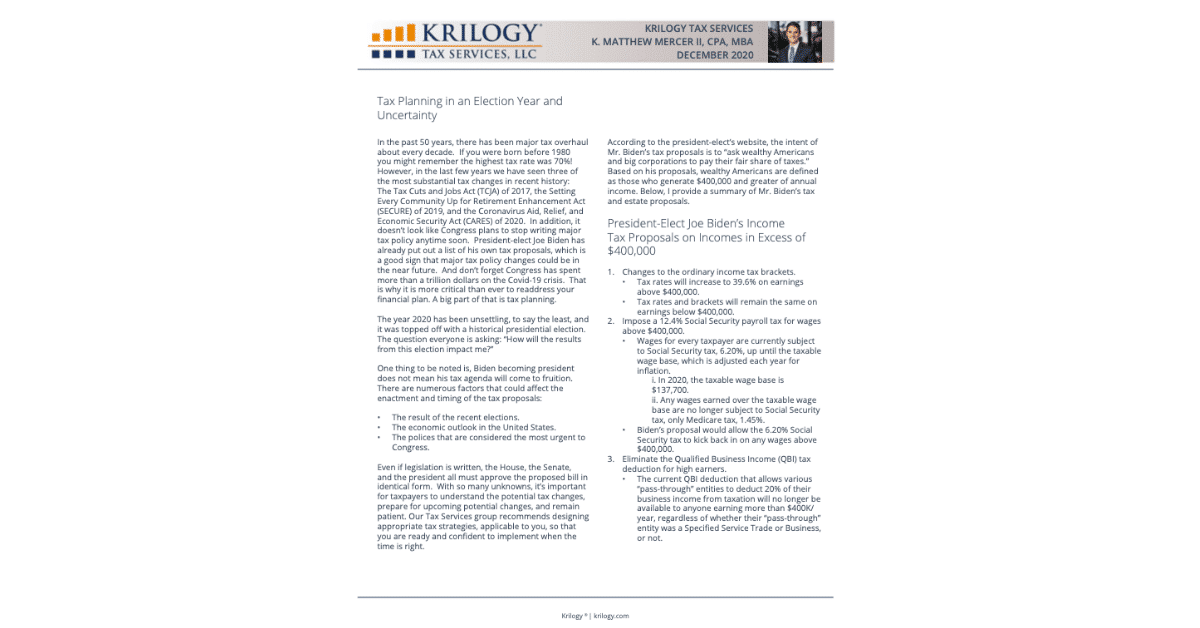
Click to download the PDF
In the past 50 years, there has been major tax overhaul about every decade. If you were born before 1980 you might remember the highest tax rate was 70%! However, in the last few years we have seen three of the most substantial tax changes in recent history: The Tax Cuts and Jobs Act (TCJA) of 2017, the Setting Every Community Up for Retirement Enhancement Act (SECURE) of 2019, and the Coronavirus Aid, Relief, and Economic Security Act (CARES) of 2020. In addition, it doesn’t look like Congress plans to stop writing major tax policy anytime soon. President-elect Joe Biden has already put out a list of his own tax proposals, which is a good sign that major tax policy changes could be in the near future. And don’t forget Congress has spent more than a trillion dollars on the Covid-19 crisis. That is why it is more critical than ever to readdress your financial plan. A big part of that is tax planning.
The year 2020 has been unsettling, to say the least, and it was topped off with a historical presidential election. The question everyone is asking: “How will the results from this election impact me?”
One thing to be noted is, Biden becoming president does not mean his tax agenda will come to fruition. There are numerous factors that could affect the enactment and timing of the tax proposals:
The result of the recent elections.
The economic outlook in the United States.
The polices that are considered the most urgent to Congress.
Even if legislation is written, the House, the Senate, and the president all must approve the proposed bill in identical form. With so many unknowns, it’s important for taxpayers to understand the potential tax changes, prepare for upcoming potential changes, and remain patient. Our Tax Services group recommends designing appropriate tax strategies, applicable to you, so that you are ready and confident to implement when the time is right.
According to the president-elect’s website, the intent of Mr. Biden’s tax proposals is to “ask wealthy Americans and big corporations to pay their fair share of taxes.” Based on his proposals, wealthy Americans are defined as those who generate $400,000 and greater of annual income. Below, I provide a summary of Mr. Biden’s tax and estate proposals.
President-Elect Joe Biden’s Income Tax Proposals on Incomes in Excess of $400,000
Changes to the ordinary income tax brackets.
Tax rates will increase to 39.6% on earnings above $400,000.
Tax rates and brackets will remain the same on earnings below $400,000.
Impose a 12.4% Social Security payroll tax for wages above $400,000.
Wages for every taxpayer are currently subject to Social Security tax, 6.20%, up until the taxable wage base, which is adjusted each year for inflation.
In 2020, the taxable wage base is $137,700.
Any wages earned over the taxable wage base are no longer subject to Social Security tax, only Medicare tax, 1.45%.
Biden’s proposal would allow the 6.20% Social Security tax to kick back in on any wages above $400,000.
Eliminate the Qualified Business Income (QBI) tax deduction for high earners.
The current QBI deduction that allows various “pass-through” entities to deduct 20% of their business income from taxation will no longer be available to anyone earning more than $400K/ year, regardless of whether their “pass-through” entity was a Specified Service Trade or Business, or not.
Biden’s Additional Tax Proposals
Itemized deductions will be capped at a 28% rate.
Taxpayers in the 32%, 35%, 37%, and the proposed 39.6% bracket will be limited to only a 28% rate on their itemized deductions, potentially increasing the taxpayer’s effective tax rate substantially.
Flat 26% credit for contributions to IRA’s, 401(k)’s, and other similar retirement accounts.
The intent of the flat deduction would be to provide more of a benefit to lower-income earners and reduce the benefit to higherincome earners.
This would replace the current deduction, so taxpayers in a marginal tax bracket above 26% would not receive the full benefit of their contribution – especially if their income will be in a higher tax bracket in the future.
However, taxpayers in a marginal tax bracket lower than 26% would receive a larger deduction than their marginal tax bracket.
This proposal would be paired with additional changes to help incentivize saving for retirement for lower-income earners.
If your income is above $1 million, your longterm capital gains and ordinary dividends will be taxed as ordinary income and will also be subject to the net investment surtax (39.6% + 3.8% = 43.4%).
However, this tax increase would only be on the long-term capital gains and qualified dividends in excess of the $1 million.
Raise corporate tax rate from 21% to 28%.
New and expanded personal income tax credits.
Increase the child and dependent care tax credits from $3,000 to $8,000 for one child and from $6,000 to $16,000 for two or more.
This credit would also now be refundable and advanceable.
Increase the child tax credit to $3,600 for children under 6 and $3,000 for all other children under 17.
Renter’s tax credit, which would reduce rent and utilities to 30% of income of certain low-income individuals.
Reintroduce the First-time Homebuyer credit, up to $15,000 and advanceable.
Biden’s Estate Planning Proposals
Eliminate step-up in basis.
This would affect any taxpayer who inherits an asset.
Step-up in basis works like this: The cost basis of the property transferred at death “steps up or down” to the fair market value at the date of death. Any tax liability due to the appreciation from the inherited property that occurred during the decedent’s lifetime is essentially eliminated.
Eliminating step-up in basis would potentially encourage capital gains realization and increase federal revenue. However, what is unknown, would be if the appreciation would be taxed at death, in essence creating an “unrealized” gains tax. This could force beneficiaries into selling desired, meaningful assets (i.e. family farm, paintings, etc.)
The silver lining is Congress has, unsuccessfully, attempted to eliminate this in the past and it would seem to still be an uphill battle. Not only does this pose political challenges, but it would also be complete chaos administratively. In most cases, it would be sending a taxpayer on a wild goose chase to figure out the original basis of an inherited asset that could have been owned by the decedent for many decades.
Federal estate and gift tax exclusion.
Reduce the estate tax exemption from $11,580,000 back to the pre-TCJA amount, which would be a reduction approximately 50%.

Krilogy Tax Services serves primarily Krilogy clients who seek additional tax advice and guidance, along with tax preparation of client’s annual tax returns. Creating and managing a client’s financial picture involves a seamless connection between financial advising and tax planning. This comprehensive approach and commitment to client service is the foundation of Krilogy.
Krilogy® does not provide tax and legal advice. Krilogy® is affiliated with Krilogy Tax Services, LLC through certain common ownership interest by Krilogy partners. Krilogy Tax Services provides tax planning and preparation services for an additional cost to Krilogy Financial clients.
Cookies and privacy
We use cookies for site function, analytics, and advertising. You can accept all, reject optional cookies, or choose categories. Privacy policy
Your browser sent a Global Privacy Control signal, so advertising sharing stays off.
Cookie preferences
Necessary cookies keep the site working. Analytics helps us understand traffic. Advertising supports ads and conversion tracking.
Your browser sent a Global Privacy Control signal, so advertising sharing stays off.
You are now leaving the Krilogy Website and will be entering the Krilogy Client Portal website.
By clicking Continue, you will be taken to a third-party website that is not operated or maintained by Krilogy. We encourage you to review their privacy policy and security level, which may differ from our own. Please know that Krilogy does not monitor the content of third-party websites, nor do we guarantee their products or services. Any opinions expressed on third-party websites are not necessarily those of Krilogy.
Schwab is a registered broker-dealer, and is not affiliated with Krilogy Financial or any advisor(s) whose name(s) appear on this Website. Krilogy Financial is independently owned and operated. Schwab neither endorses nor recommends Krilogy Financial, unless you have been referred to us through the Schwab Advisor Network®. Regardless of any referral or recommendation, Schwab does not endorse or recommend the investment strategy of any advisor. Schwab has agreements with Krilogy Financial under which Schwab provides Krilogy Financial with services related to your account. Schwab does not review the Krilogy Financial Website, and makes no representation regarding the content of the Website. The information contained in the Krilogy Financial Website should not be considered to be either a recommendation by Schwab or a solicitation of any offer to purchase or sell any securities.
By clicking Continue, you will be taken to a third-party website that is not operated or maintained by Krilogy. We encourage you to review their privacy policy and security level, which may differ from our own. Please know that Krilogy does not monitor the content of third-party websites, nor do we guarantee their products or services. Any opinions expressed on third-party websites are not necessarily those of Krilogy.
You are now leaving the Krilogy Website and will be entering the Krilogy Tax Portal website.
By clicking Continue, you will be taken to a third-party website that is not operated or maintained by Krilogy. We encourage you to review their privacy policy and security level, which may differ from our own. Please know that Krilogy does not monitor the content of third-party websites, nor do we guarantee their products or services. Any opinions expressed on third-party websites are not necessarily those of Krilogy.
Krilogy Tax Services is a wholly owned subsidiary of Krilogy, LLC, Krilogy’s parent company. Krilogy Tax Services provides tax planning and tax return preparation services to Krilogy clients. Krilogy does not provide tax advice. All fees incurred for Krilogy Tax Services are separate and apart from any fees charged by Krilogy.
By clicking Continue, you will be taken to a third-party website that is not operated or maintained by Krilogy. We encourage you to review their privacy policy and security level, which may differ from our own. Please know that Krilogy does not monitor the content of third-party websites, nor do we guarantee their products or services. Any opinions expressed on third-party websites are not necessarily those of Krilogy.