


4 MIN READ
 4 MIN READ

Q2 2026 at a Glance
+15.2%
S&P 500, Q2 total return
2nd best
Nasdaq-100 quarter in 25 years
+24.1%
MSCI EM, Q2 total return
4.47%
10-year Treasury, quarter-end yield
What We’re Watching
- U.S. equities posted one of the strongest quarterly advances of this century. The S&P 500 gained 15.2% as a Middle East peace framework and accelerating earnings overwhelmed a historically bearish seasonal window.
- The Fed repriced from cuts toward a possible hike. Under new chair Kevin Warsh, the June median projection now implies at least one hike by year-end, and the 2026 headline inflation forecast rose to 3.6%.
- With the S&P 500 near 20 times forward earnings, margin debt elevated, and cash allocations low, we favor cautious optimism, rebalancing, and diversification over added risk-taking.
Q2 2026 Review
| Index | QTD | YTD | 1-Year |
|---|---|---|---|
| S&P 500 | +15.2% | +10.2% | +22.3% |
| NASDAQ | +21.6% | +13.1% | +29.5% |
| Dow Jones | +13.4% | +9.8% | +20.6% |
| Russell 2000 | +21.5% | +22.6% | +40.8% |
| MSCI EAFE | +10.8% | +9.4% | +20.2% |
| MSCI EM | +24.1% | +23.8% | +43.5% |
| Bloomberg US Agg Bond | +0.7% | +0.6% | +3.8% |
Source: Morningstar Direct, as of 6/30/2026.1
Equity Market
Coming into the second quarter, we cautioned that we were entering the most historically bearish stretch of the four-year presidential cycle and that continued volatility was likely. Volatility did arrive, but the destination surprised nearly everyone2.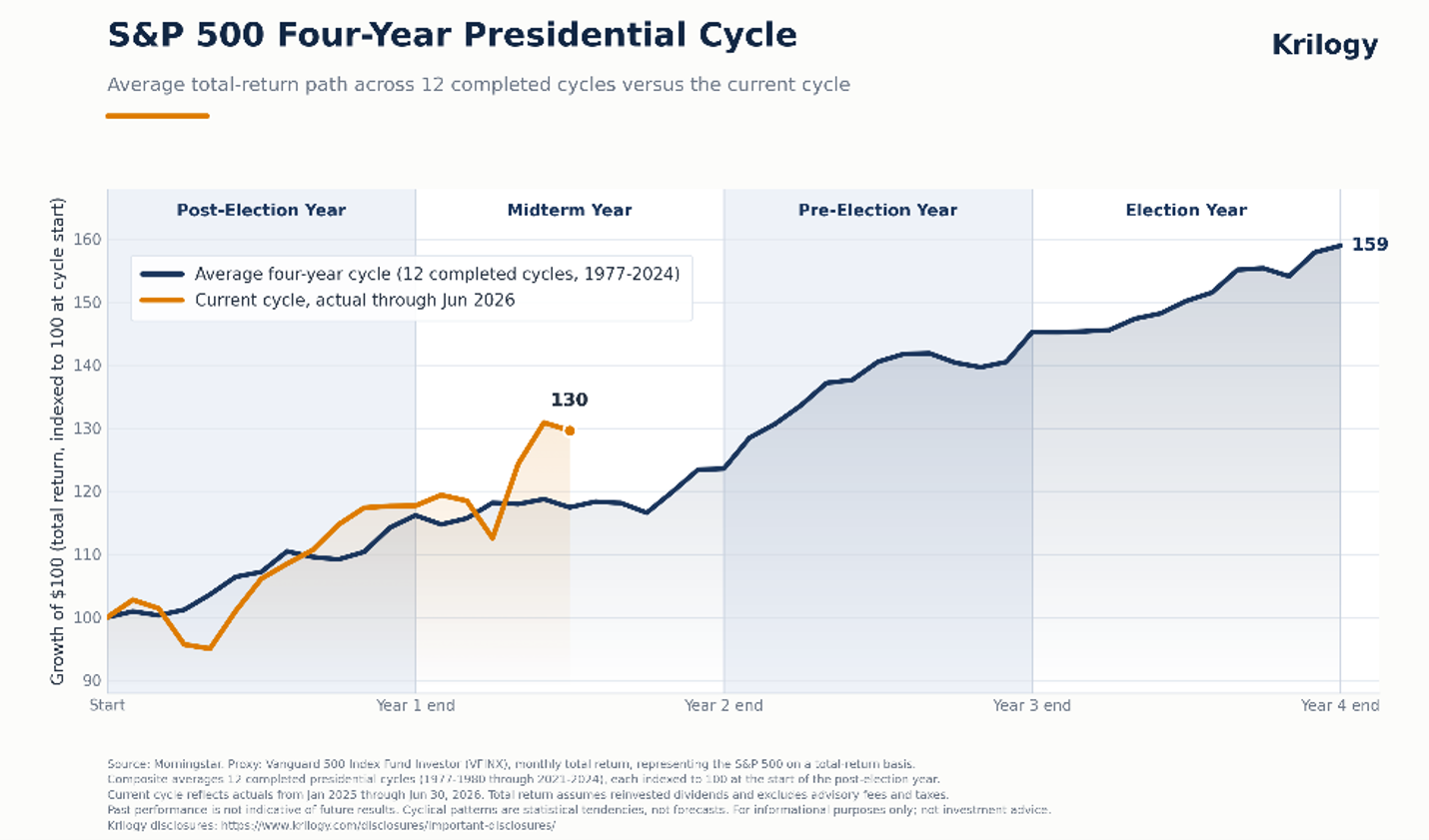 Following the first quarter’s decline, U.S. equities staged one of the strongest quarterly advances of this century. The S&P 500 returned 15.2% for the quarter, its best showing since the second quarter of 20201, while the Nasdaq-100 notched its second-best quarterly performance of the last 25 years. The rally began with large-cap growth and the hyperscalers, but by quarter-end the advance had broadened meaningfully, with small-cap, micro-cap, equal-weight, and value benchmarks all reaching new record highs.
Two forces drove the turnaround. The first was progress toward peace in the Middle East. After Brent crude peaked near $118 per barrel in April, ceasefire negotiations between the U.S. and Iran gained traction, and oil posted its worst monthly decline since the pandemic in May, falling roughly 19%. June’s memorandum of understanding to reopen the Strait of Hormuz and lift of the naval blockade pushed prices even lower. Despite late-June flare-ups that reminded investors the ceasefire remains fragile, Brent crude ended the quarter near $73 per barrel, almost exactly where it stood before the conflict began on February 28. In other words, oil made a complete round trip in the span of four months.
The second force was earnings. First-quarter results reported during the quarter delivered 29% year-over-year earnings growth, the strongest since 2021, on 12% revenue growth, the strongest since 20223. Technology and communication services led the way, and the AI trade that sold off so sharply in the first quarter came roaring back as hyperscaler results suggested the massive capital spending is beginning to bear fruit. The rotation we highlighted last quarter reversed with force. Large-cap growth returned 16.7% versus 13.9% for large-cap value, small caps led all style boxes with the Russell 2000 up 21.5%, and IPO activity returned in a big way, headlined by SpaceX’s public listing. Foreign markets participated as well: developed international equities gained 10.8% for the quarter, and emerging markets surged 24.1%, led by Korea and Taiwan and their central position in the AI supply chain.
Fixed Income Market
| Bond Sector (Morningstar Index) | Q2 Return | 1-Year Return |
|---|---|---|
| US Treasury Bond | +0.3% | +2.7% |
| US Mortgage-Backed Securities | +0.6% | +5.3% |
| US Core Bond | +0.7% | +3.8% |
| US Corporate Bond | +1.4% | +4.3% |
| LSTA US Leveraged Loan | +1.9% | +4.3% |
| US High-Yield Bond | +2.4% | +5.8% |
| Emerging Markets Sovereign Bond | +3.4% | +8.4% |
Source: Morningstar Direct, as of 6/30/2026.4
Economic
The labor market that looked so worrisome three months ago has steadied. May nonfarm payrolls rose 172,000 against expectations of roughly 88,000, and the unemployment rate held at 4.3%, little changed over the past year. Inflation is now the clearer concern. The energy shock from the first quarter worked its way through the price data, lifting core PCE to 3.4% year over year in May, its highest reading since 2023, and pushing headline consumer inflation to its highest level in more than three years. The good news is that the source of the pressure, oil, has already retraced. The open question for the second half is how quickly that relief shows up in the inflation prints, and whether the underlying trend beneath the energy noise remains contained.Q3 2026 Outlook
Equity Market
Last quarter we wrote that seasonal studies are just statistical descriptions of the past, but that it is unwise to ignore the roadmap. The second quarter offered the other half of that lesson: seasonality is a tendency, not a law. The most historically bearish quarter of the presidential cycle produced one of the best quarters in a generation, because fundamentals, in this case a peace framework and an earnings acceleration, overwhelmed the calendar. That said, the seasonal roadmap still points to choppier trade from here into early October, which has historically marked the low for the entire cycle before a stronger post-midterm stretch. We would not be surprised to see the market consolidate its gains during the quarter. The fundamental backdrop argues for staying invested through that chop. Second-quarter earnings season begins in mid-July, with the index expected to deliver 23.3% year-over-year earnings growth and 12.2% revenue growth, marking the second consecutive quarter above 20% and the seventh consecutive quarter of double-digit growth9. Just as notable, analysts raised estimates during the quarter by 3.4%, when the typical pattern is a decline of about 2%.9 The spending underpinning this cycle continues to build, with the largest technology companies on track to invest nearly $700 billion in capital expenditures in 2026, up 36% from last year, alongside rising investment in energy infrastructure and defense. The S&P 500 now trades at roughly 20 times forward earnings, modestly above both its 5-year and 10-year averages. Earnings strength has brought valuations out of the extreme ranges of 22-23x. We believe investors should remain prudent as any slip in earnings from the major tech companies could be a catalyst for volatility to spike and the market to experience a selloff. The ceasefire in the Middle East, while encouraging, remains fragile, as the late-June exchange of strikes demonstrated. And after a 15% quarter, positioning and sentiment have swung a long way from the pessimism of early April.A Technical View
The historical record puts this advance in rare company. Gains of this size are common immediately after a bear market ends: the largest quarterly gains in U.S. stock market history occurred in 1932, 1938, and 1975, and more recently the second quarter of 2020 (19.95%), the second and third quarters of 2009 (15.22% and 14.98%), and the second quarter of 2003 (14.90%) all followed severe declines. Extreme gains arriving after a prolonged period of market strength, however, are rare. The handful of comparable episodes offers a mixed but cautionary record:- Q4 1999 (14.54%): the technology bubble burst the following quarter.
- Q2 1997 (16.90%): the bull market ran roughly three more years, though the early-2000s bear market revisited this price range.
- Q1 1987 (20.46%): the S&P 500 topped later that year and gave way to the 1987 crash.
- Q4 1985 (16.04%): the top arrived two years later, but the 1987 crash revisited this price range.
- Q3 1939 (17.77%): the market declined more than 40% before bottoming in the second quarter of 1942.
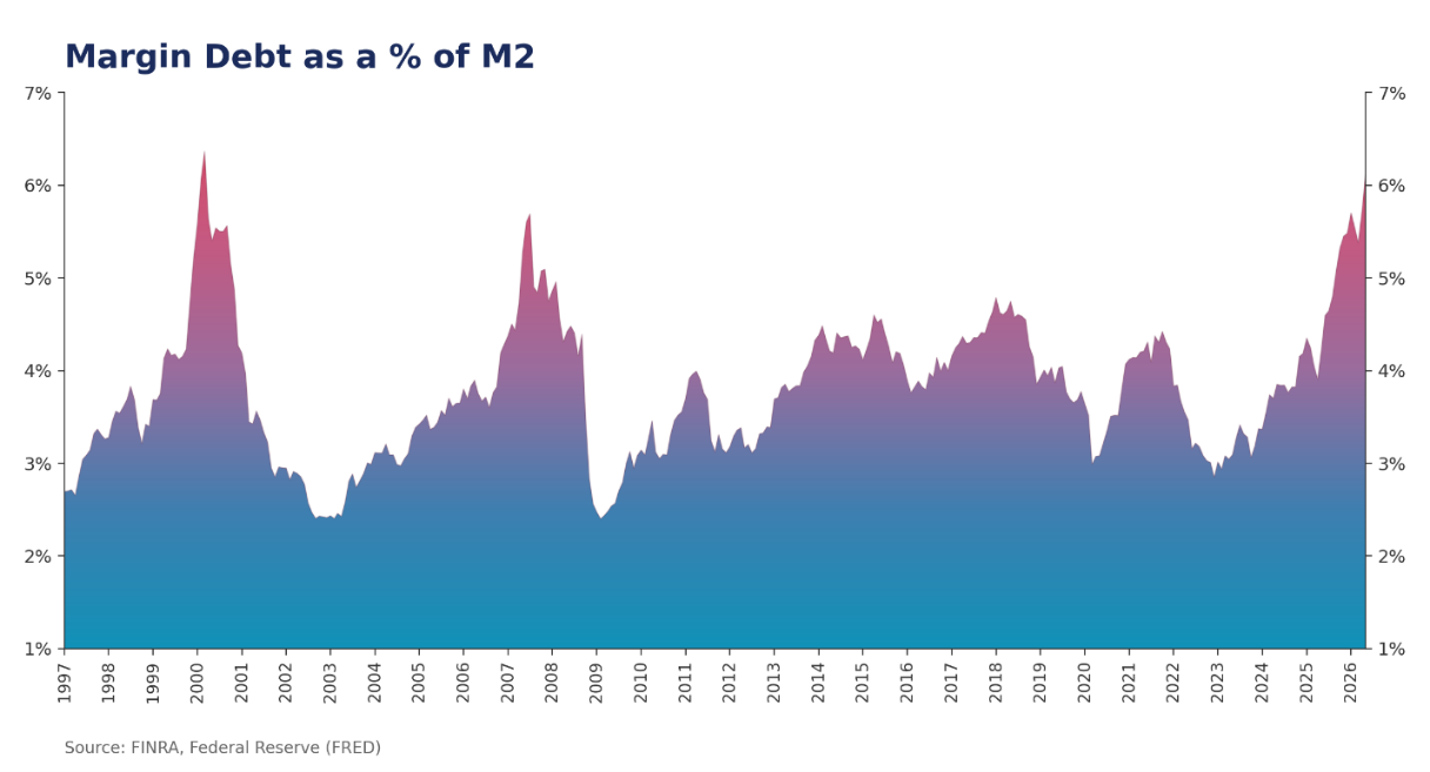 Retail investors’ cash allocation tells the same story. Cash allocations at or below 15%, as measured by the American Association of Individual Investors, have been recorded only in 1998, 2000, 2018, 2020, and 2021, and the S&P 500 declined at least 20% following each of those readings. Elevated margin debt and low cash balances convey the same reality: investors are all in, a setup that has historically preceded downturns in equity prices. None of this is a timing signal, but taken together with valuations, sentiment, and seasonality, it reinforces why risk control and diversification remain paramount.
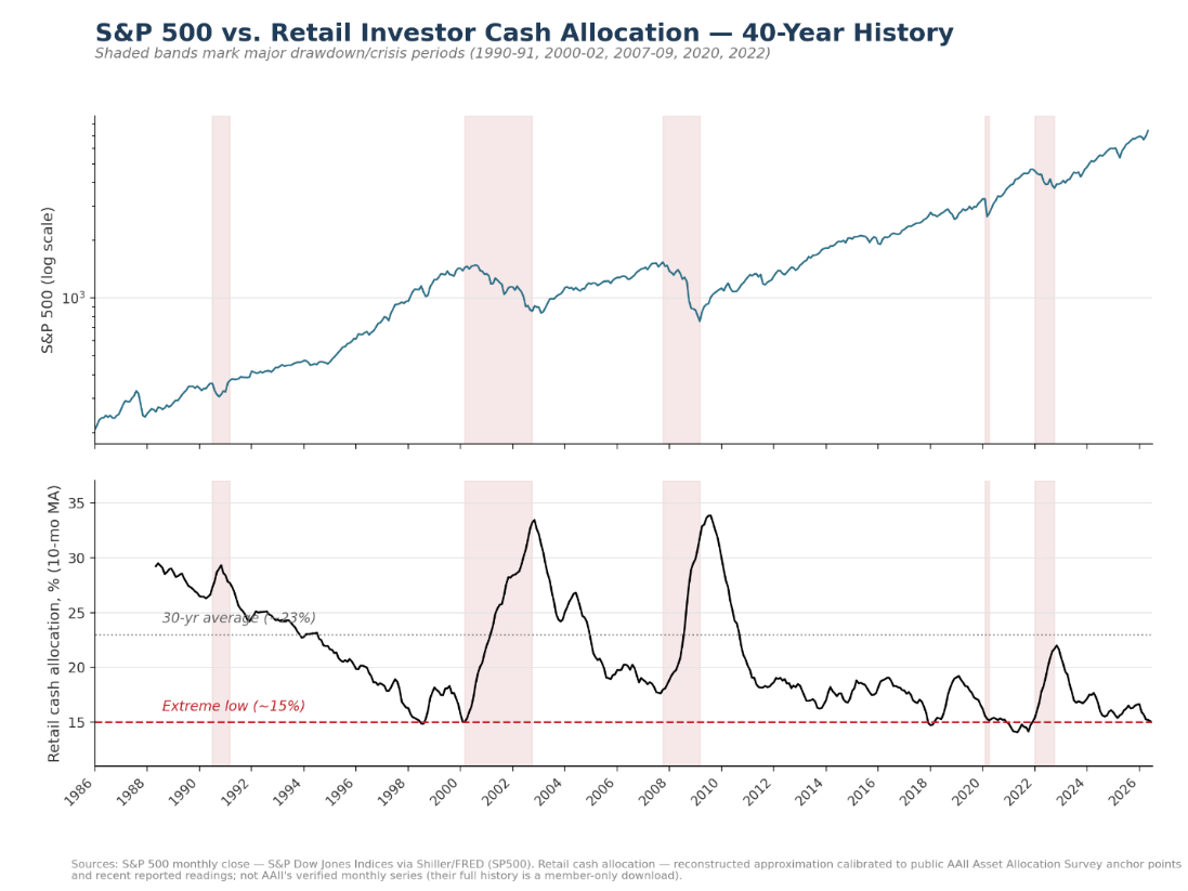 Our conclusion is familiar, because the discipline does not change with the direction of the market. A quarter like this one is precisely when adhering to target allocations matters most. Rebalancing after a sharp rally means trimming what has run and topping up what has lagged, which is simply risk management executed while conditions are calm. This remains a market for cautious optimism rather than risk-taking.
Fixed Income Market
The events of the quarter reinforced our long-standing view that rates will be higher for longer, though the risk has shifted from cuts arriving late to a hike arriving early. With the committee openly discussing tightening and inflation still working through the energy shock, we expect rates to move sideways to modestly higher over the next six to twelve months. We continue to believe the 5% level on the 10-year Treasury likely marked the cycle high. The 10-year peaked at 4.67% during a quarter that included a war, a Fed transition, and an inflation spike, which strikes us as a meaningful test of that view. A retest of higher levels is possible if the ceasefire fails or inflation proves stickier than expected, but we would expect it to be short-lived. Positioning-wise, we believe the asset class continues to offer an attractive risk and return skew. Yields near current levels allow income to do the heavy lifting, and high-quality bonds retain plenty of room to provide negative correlation benefits in the event of a genuine risk-off moment. With credit spreads at historically tight levels, we see little compensation for reaching into lower-quality credit and prefer to keep the quality bias intact.Conclusion
If the first half of 2026 proves anything, it is how quickly the story can change. In the span of four months, markets went from pricing a regional war and an oil shock to setting record highs on peace talks and earnings strength. Investors who reacted to the headlines of March missed the recovery of the second quarter. Every market has its risks and tailwinds, but what is of utmost importance is ensuring that your allocations align with your desired level of risk. Having an appropriate strategic allocation that allows you to achieve your long-term financial goals at your desired risk level is the biggest help when navigating markets that can swing this widely, in either direction, this fast. At Krilogy®, we are committed to helping you effectively navigate the ever-changing market environment. As long-term investors, we believe it is critical to remain patient and stick to the plan that was developed for your unique situation to arrive at a personal allocation target. Our entire team remains dedicated to helping you achieve your financial goals.Sources
- KPS Research, Morningstar Direct, as of 6/30/2026
- KPS Research, Morningstar Direct, as of 6/15/2026
- FactSet Research, Inc., Earnings Insight: https://www.factset.com/earningsinsight
- KPS Research, Morningstar Direct, as of 6/30/2026
- KPS Research, Morningstar Direct, as of 6/30/2026
- Morningstar, “How Bond Funds Fared in Q2 2026,” 7/1/2026: https://www.morningstar.com/funds/how-bond-funds-fared-q2-2026
- Federal Reserve, FOMC Statement, 6/17/2026: https://www.federalreserve.gov/newsevents/pressreleases/monetary20260617a.htm
- CNBC, “Fed holds rates steady in Warsh’s first meeting, signals possible hikes ahead,” 6/17/2026: https://www.cnbc.com/2026/06/17/fed-interest-rate-decision-june-2026.html
- FactSet Research, Inc., “S&P 500 Earnings Season Preview: Q2 2026,” 7/2/2026: https://insight.factset.com/sp-500-earnings-season-preview-q2-2026